
Because of the economic slowdown, the actual corporation tax collection in 2012-13 was at Rs 3,56,326 crore (Rs 3,563.26 billion), up 10.4 per cent year-on-year as against 15.6 per cent estimated in the Budget.
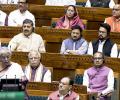
Finance Minister Nirmala Sitharaman on Tuesday announced income tax relief for the middle class, a Rs 2 lakh crore outlay for job creation schemes over the next five years and a spending splurge for states run by her party's new coalition partners as she unveiled the Modi 3.0 government's first budget after the general elections.
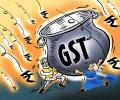
Economic Advisory Council to the Prime Minister (EAC-PM) chairman Bibek Debroy on Tuesday said the government was losing revenue due to the GST, which should be revenue neutral with a single rate. Speaking at an event organised by the Calcutta Chamber of Commerce in Kolkata, he however said that GST has led to a lot of simplification. "The ideal GST is one that has a single rate, and it was meant to be revenue neutral.

The new government that presents the full Budget for 2024-2025 in July should be ready to restructure the way divestment is managed and implemented, proposes A K Bhattacharya.
The immediate revenue loss could worsen the Centre's fiscal deficit, from the budgeted 3.3 per cent of gross domestic product (GDP) to 3.7 per cent of GDP -- a massive 40-basis-point increase. It was stabilised at 3.4 per cent since 2016-17, report Abhishek Waghmare and Dilasha Seth.

'The government should act proactively to instil confidence in the private investors, and also boost the purchasing power of people directly or indirectly by ensuring minimum wages.'
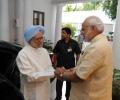
'The sense of Constitutional propriety and political morality seems to be vanishing fast.' 'There are many things in today's politics of governance which Manmohan Singh would have never dreamt of saying or doing.'

After helping the government in policymaking since October 2014, Chief Economic Adviser Arvind Subramanian is returning to academics and will be teaching at Harvard Kennedy School on a visiting position. In an interview to Dilasha Seth and Somesh Jha, he says the ease of doing business agenda needs to move forward and India must try to integrate with the global value chains. Edited excerpts.

Govt has drawn list of PSUs for strategic sale: Jaitley

Though Beijing asserts the Dalai Lama's successor needs its approval, observers say it remains concerned as the present Panchen Lama, the number two spiritual leader who was appointed by it after unseating the boy nominated by the Dalai Lama, has not gained much traction in Tibet.

After bumbling for years since 2014, the Modi government seems to believe that massive government expenditure will lead us to prosperity supported by 'seat-of-the-pants' decision-making, observes Debashis Basu.

The impact of AI automation in India is the lowest.

If government statistics are at variance with private data flow, chances are high that the latter presents a picture closer to reality.

'The prime minister's comment on 'revdi culture' was welcome. But I am disappointed he did not follow up on that.' 'All political parties, including the BJP, have been guilty of this.' 'Now, Modi's guarantees, the Congress's 'nyay' path and both ruling and Opposition parties are vying with each other for freebies in my home state Andhra Pradesh.'
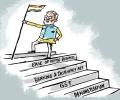
India's GDP expanded 13.5 per cent in the April-June quarter, the quickest pace in a year, to retain the world's fastest growing economy tag but rising interest costs and the looming threat of a recession in major world economies could slow the momentum in the coming quarters.

'That is the one headline the world is reading about India this week, and it is a potentially damaging story...' 'I don't think a panic mentality has set in, but this story is one that investors and market watchers are absolutely seized with.'

The increased amount, defence sources say, will be consumed mostly by the allocation for employees-related expenses, salaries and allowances of servicemen.

'What happens in the real estate market is that once the prices go up it goes on to stay at that level.' 'It might not increase and at the same time the prices will not come down too.'

She has shown shrewdness, sensitivity, and courage. All of these will be needed in ample quantities for the real challenge that will emerge after the elections, notes Shreekant Sambrani.
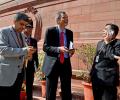
'We now look at divestment as an opportunity for maximising the value of public assets, not necessarily as a short-term resource-raising measure.'

After bumbling for years since 2014, the Modi government seems to believe that massive government expenditure will lead us to prosperity supported by 'seat-of-the-pants' decision-making, observes Debashis Basu.

Global rating agency Fitch said on Monday that bank credit growth in excess of 13 per cent year on year in FY23 could put pressure on core equity tier ratios (CET1) of banks, especially public sector lenders. It may limit the buffers of Indian banks to absorb potential future losses. Bank credit expanded by 11.5 per cent in FY22. Full-year loan growth for FY23 will represent a modest slowdown from the 17 per cent YoY pace in H1FY23.

After the government sought Parliament's nod for a second batch of supplementary demand for grants that will cause a hit of Rs 2.99 trillion to the exchequer, doubts suddenly arose about the government's ability to meet the Budget projections of reining in its fiscal deficit at 6.8 per cent of gross domestic product (GDP), or Rs 15.06 trillion, for the current financial year. Till now, many were of the opinion that the government would succeed in checking the deficit at a much lower figure than what was given in the Budget Estimates (BE). The government had sought Parliament's approval to spend Rs 3.74 trillion extra, but Rs 74,517.01 crore will be matched by equal savings on other heads.

Sounding a note of caution, former Reserve Bank Governor Raghuram Rajan has said that India is "dangerously close" to the Hindu rate of growth in view of subdued private sector investment, high interest rates and slowing global growth. Rajan said that sequential slowdown in the quarterly growth, as revealed by the latest estimate of national income released by the National Statistical Office (NSO) last month, was worrying. Hindu rate of growth is a term describing low Indian economic growth rates from the 1950s to the 1980s, which averaged around 4 per cent.

The finance minister has stayed true to her commitment to fiscal consolidation, even though the pace of the decline in the deficit could have been faster, notes A K Bhattacharya.

'Without a poverty line, how are we to know whether poverty is the same, or it has come down or it has gone up?'

India's macroeconomic fundamentals are strong to deal with global challenges and the central government is committed to sticking to the fiscal deficit target of 6.4 per cent of the GDP for the current fiscal, official sources said on Monday. The government is taking steps to deal with the spiralling crude oil prices in the international market, the sources said. India meets nearly 85 per cent of its oil demand through imports and a weaker rupee makes imports costlier.

'Our Left is squeamish about democracy. They are so mechanical they have only dogma.'

The recent surge in crude oil prices could shave off the gains made by India Inc in profit margins in the past few quarters. Worse, it comes at a time when consumer demand in the country is slipping and major global economies are witnessing a slowdown. A back-of-the-envelope calculation suggests that the margin expansion accounted for three-fourths of the rise in the listed firms' operating profit between the April-June quarter (Q1) of FY23 and Q1FY24, and only a quarter of profits gains came from revenue growth.

The economy, though projected to grow 9.6 per cent in the next financial year in year-on-year growth term, may grow just 1 per cent in real terms to Rs 147.17 lakh crore as against Rs 145.66 lakh crore in 2019-20, at the 2011-12 prices, according to a report by India Ratings. The size of the economy, as per the National Statistical Office's data, had stood at Rs 145.66 lakh crore in 2019-20, at the 2011-12 prices. According to the rating agency, the country's gross domestic product (GDP) is expected to contract 7.8 per cent to Rs 134.33 lakh crore in 2020-21, but may grow 9.6 per cent to Rs 147.17 lakh crore in 2021-22.

'The pipeline of new industrial projects is the best I've seen in the last 10 years, and it looks solid enough to sustain for at least a few quarters,' points out Naushad Forbes, adding, 'It is only when we get back to the same labour force participation we saw before Covid that the economy will have truly recovered.'

The public sector banks are not in a position to cut rates because of their weak balance sheets and massive portfolios of non-performing assets, says Devangshu Datta.

Key Planning Commission official says push from small-scale industries will help reach the figure, but others disagree.

When he didn't respond (Mr Saver has lost count of how many relationship managers he has had in the past few years!), the gentleman landed up at his doorstep and started pleading with him to open fixed deposits with the bank, observes Tamal Bandyopadhyay.

Without naming India, S&P said it expects that in regions where inflation already exceeds targets, or which are vulnerable to capital flight, central banks will be forced to raise interest rates.

Instead, 2019-20 could be the base from which the Budget estimates for next year are calculated.

The Life Insurance Corporation of India has the wherewithal to acquire a composite license, a top source aware of the development told Business Standard, adding that the insurance behemoth may look into entering the health and general insurance segments. "LIC has the scale, capacity, IT infrastructure, and the distribution reach to take advantage of the composite license. "LIC is looking at organic as well as inorganic growth opportunities.

The sharpest contraction of the American economy in a decade is expected to get worse in the second quarter. White House senior economic adviser Kevin Hassett said that they expected second-quarter negative GDP growth between minus 15 and minus 20 per cent.
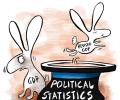
It is also likely to assume a deflator of around 4 per cent. That could take the nominal GDP outlook for FY21 to around 10 per cent. It is this nominal GDP forecast on the basis of which the finance ministry is calculating key Budget targets like the fiscal deficit as a percentage of GDP and tax revenue growth for the coming year.

The failure of SVB was due to idiosyncratic reasons, but shows how higher rates can expose fault lines in unforeseen places, observes Neelkanth Mishra.
